Advert


A comprehensive book on the principles of AI
The AI revolution can be of great benefit to architects if the profession navigates this change carefully, argues Phil Bernstein, Deputy Dean at the Yale School of Architecture and a former vice-president at Autodesk.
Phil Bernstein: Machine Learning: Architecture in the age of Artificial Intelligence. RIBA Publishing 2022 (2nd revised edition 2025). 200 pages.
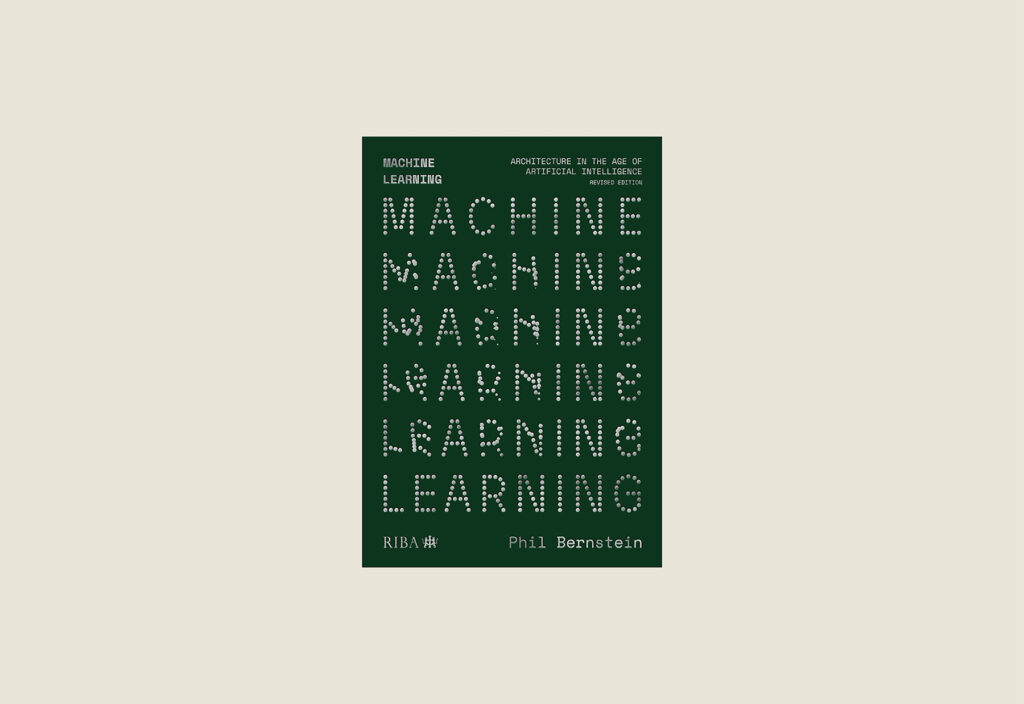
What does the future of architectural practice look like in the age of Artificial Intelligence? In Machine Learning, Phil Bernstein, Deputy Dean at the Yale School of Architecture and a former vice-president at Autodesk, provides a holistic overview of developments in architectural technology from the late-1970s until the present day, and speculates on the impact advances in Artificial Intelligence (AI) might have on the profession.
The book explores AI in architectural practice through three lenses: The “Process” chapter introduces theoretical frameworks and describes the current schema of architectural practice; the “Relationships” chapter examines AI in relation to law, training and economics; and the “Results” chapter sets out Bernstein’s vision for the future.
The scope of the book is admirable, seeking to go far beyond questions of AI’s present-day practicality and provide thought-leadership for our response to this emerging technology. Bernstein is a charismatic host, with personal stories from his decades in practice, sales and academia liberally regaled. However, he also has an academic’s penchant for categorisation, which leads to an array of grids, tables and charts analysing the differences between practice frameworks in the UK and US, naming conventions preferred by various theorists and Bernstein’s own painstaking overlays. These sometimes feel superfluous and, if anything, serve to make the already complex subject matter more convoluted than necessary.
Despite this, Bernstein is an authoritative voice and there are valuable insights throughout. He addresses the fear that architects could be replaced entirely by AI with a reassuring arm around the shoulder: not for a long time. Whilst the average practitioner may not be seriously asking if AI will make architects redundant, Bernsteins logic for rejecting this concern is illuminating. Large language models (LLMs), such as Chat GPT, have proliferated rapidly due to their training on decades-worth of text trawled from the internet: the dataset is enormous. Architectural projects, on the other hand, comprise data which is too dispersed, disparate and disorganised to be of immediate use: there are proprietary formats for almost every program and datasets are rarely intelligently or consistently linked to each other within an individual project, let alone across offices, sectors or borders.
Architectural projects comprise data which is too dispersed, disparate and disorganised to be of immediate use.
Bernstein argues, however, that the AI revolution can be of great benefit to architects and cautions that the profession will need to navigate this change carefully, and in conjunction with the wider construction industry. Bernstein holds that architects need to be proactive in this regard, and have a clear sense of direction amidst the melee of change. He suggests the establishment of a building data trust, which would act as a repository for all of a nation’s building data, in anonymised, consistent and usable formats. The book details ways in which this data could be used to train industry specific AI models, which could help architects instantly access specialist knowledge; assess compliance to regulations; make the construction of buildings more efficient; or even lead to the utilisation of AI programmed robots for certain construction tasks.
In a professional landscape where the traditional separation between architect and contractor is receding, this kind of data sharing may not be as far-fetched as it instinctively feels, although Bernstein accepts that a huge shift in mindset and industry economics would be required for companies to sacrifice their competitive edge in order to share data with established rivals. In Finland, the Ministry of the Environment’s recent decree on the content of construction plans and government reviews has enshrined the requirement for a BIM model to be submitted at building permit stage. Could this data one day form the backbone of a Finnish building data trust?
If you are seeking a manual for integrating AI into your current workflow, this book is not for you, Bernstein barely mentions the kinds of uses prevalent in current practice. Rather, Machine Learning makes valuable reading for advocates and decision-makers; those at the Finnish Association of Architects and its equivalent organisations across Europe would be wise to take note. As Bernstein writes, “We can’t leave this important destiny to the sole discretion of the vendors”.
Also these might interest you





Advert