Advert
How to design cities that nurture joy
Examining the city through the lens of urban joy reveals the importance of preserving spontaneity, informality and the freedom to use spaces without purpose, argues Merve Ünlü.
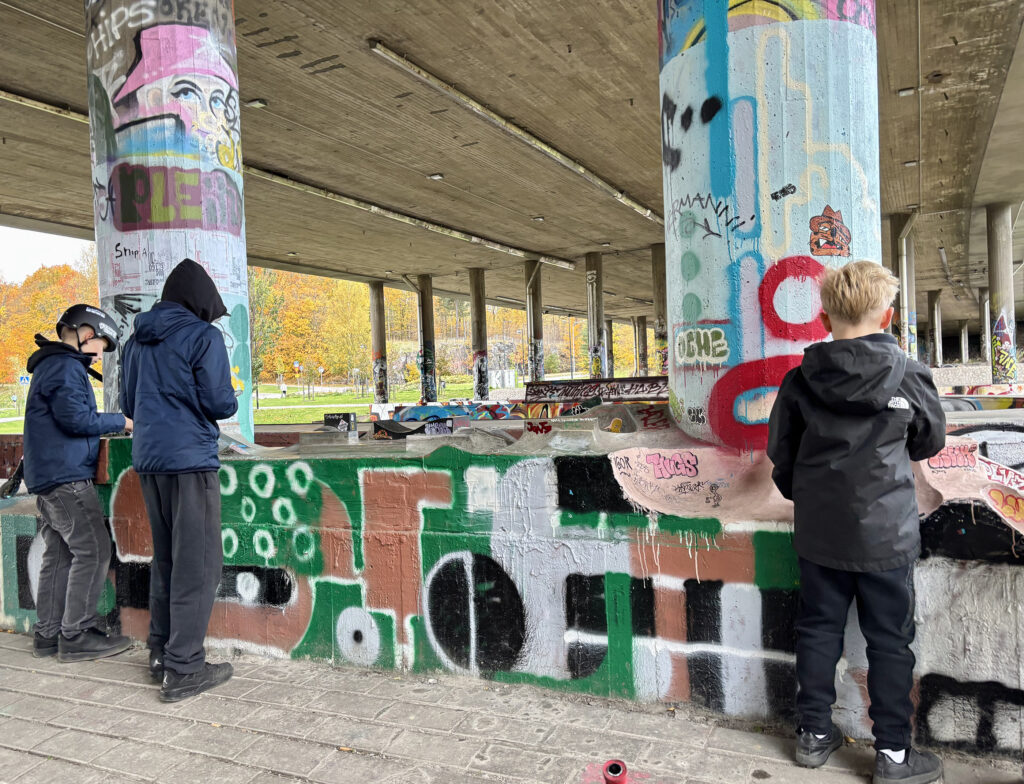
ON THE EDGE OF A SKATEPARK under a highway bridge in the Hermanni neighbourhood of Helsinki, kids film fingerboard tricks on miniature DIY ramps. True to skate culture, the whole space is improvised and shaped by its users rather than formal design, turning what could be an unpleasant leftover space into an active, social one where you can see dance rehearsals, underground parties and concerts. When tram construction threatened its existence, people defended its value. Today, it remains an attractive, informal and adaptable urban space, which is rare in Helsinki.
Helsinki is a safe and comfortable city where participation is embedded in planning through initiatives such as OmaStadi, placemaking projects and participatory budgeting. These democratic practices are foundational for creating the conditions for residents to participate in urban decisions. While these city-led projects succeed in making urban space more inclusive and functional, they can also produce environments that feel overly polished and neutral. Even a “perfect” public space, by conventional standards, does not necessarily capture everyone’s imagination or invite spontaneity and joy. What would a city built for joy look like, then?
Even a “perfect” public space, by conventional standards, does not necessarily capture everyone’s imagination or invite spontaneity and joy.
The Urban Joy Lens
Urban joy is a term I use to refer to moments of delight, comfort and belonging that emerge through interactions between people, urban space and the social dynamics within it. As an embodied spatial experience, urban joy reveals how people relate to public spaces beyond safety and wellbeing. It often appears in informal, overlooked or appropriated environments where people choose to spend time, sometimes beyond the intentions of design. My favourite park in Helsinki, for instance, is neither the cleanest nor the most carefully designed. It is a small, slightly neglected green patch wedged between apartment buildings on a steep hill. But it offers something rare: the freedom to occupy space without purpose.
My current art and urbanism project, funded by the Finnish Cultural Foundation, examines real moments of urban joy and speculates about the design of a joyful neighbourhood in Helsinki. I organised a public workshop where participants mapped Helsinki based on personal experiences, revealing both the diversity and consistency of emotional responses to spaces. Shared examples included the the open and diverse terrain around Lapinlahti’s former psychiatric hospital, which today functions as a communal centre for culture and well-being, the atmosphere of Central Library Oodi’s urban living room, and the subtle landscape design of Töölönlahti. Many of the most memorable experiences were tied not to major landmarks, but to smaller and more intimate situations: the view of the railway from a bridge, a shortcut along the water’s edge, snow piles dampening the sounds of heavy traffic in Pasila, and people-watching in Esplanadi Park. These often accidental moments with big impacts on daily life reveal how small actions by residents can impact and inform larger strategies.
While larger city-led projects like Oodi act as urban magnets, attracting different activities in one place, urban joy can grow from much smaller actions that are spread across entire neighbourhoods. Some of these are initiated by the city: a small deck, a bench along a long walking route or a soft street corner that quietly improves the daily experience. And then, equally, if not more importantly, there are resident-led actions that emerge without formal planning: urban art, repurposed spaces, improvised gathering spots or simply places where people choose to linger.
These acts and the emotional connection to spaces often escape current analytical standards, but the urban joy lens makes them visible. In this sense, urban joy is not produced through a single iconic intervention, but through the accumulation of small actions that promote feelings of attachment and freedom. Many beloved public spaces begin that way: claimed first by people, then supported by design and policies. For example, Helsinki’s Sompasauna is a self-built public sauna, created without official permission, that evolved into one of the city’s most beloved communal spaces. Its appeal lies not in polished design, but in its sense of openness, autonomy, and shared ownership.
Urban joy is not produced through a single iconic intervention, but through the accumulation of small actions that promote feelings of attachment and freedom.
When to Leave Things Untouched?
Designing for joy is, therefore, not about prescribing happiness or creating overly programmed environments. In fact, excessive design can limit spontaneity by dictating how space should be used. Street art, for instance, once widely dismissed as vandalism, is now embraced as a valuable subculture in Helsinki. Mural artists are commissioned, and areas like Suvilahti, Pasila and Kalasatama are promoted as street art destinations. At its core, street art has always been self-expression rooted in context, responding to social and political realities. When confined to designated spaces or curated programming, it risks losing the spontaneity and edge that once defined it. The challenge lies in recognising which small actions can inform broader strategies, and which ones should remain unstructured.
This does not mean abandoning design altogether, but rather rethinking its role. At a larger scale, urban joy could become a layer in planning processes alongside standard metrics. Methods that are familiar to urban designers, like walking workshops, observational studies and participatory mapping, can have a new use with the added urban joy layer to help to identify where people already linger, improvise, and form attachments. Rather than treating informality as a disruption, planning could recognise it as feedback revealing how people wish to use their city. This way, the city can build upon existing observations of urban joy.
People are not trying to save places such as Suvilahti or Lapinlahti because there are no other places to go, but because they have formed an emotional attachment to them.
Places like Suvilahti, Sompasauna and Lapinlahti show how layered, partly informal spaces can create a stronger sense of belonging than overly finished environments. Yet these culturally unique and beloved places are often threatened by profitable development. In 2022, plans to sell and redevelop Lapinlahti Hospital sparked strong civic resistance, while a DIY skate park in Suvilahti will be demolished despite public opposition and appeals.
People are not trying to save these places because there are no other places to go, but because they have formed an emotional attachment to them. The challenge is not only to create new spaces of urban joy, but to recognise and protect the ones that already exist, even in messy, improvised or economically undervalued places. And when development is inevitable, how do we invite joy to populate the new space?
Urban joy is subjective and, therefore, difficult to define, but it is not impossible to recognise. It exists in the small, often overlooked actions that bring life to public space. By paying attention to these informal, personal moments, we can better design cities that are not only functional, but also inspiring, spontaneous and alive.
Also these might interest you

Advert