Advert


New Historicism and the Value of Novelty
In recent years, a new type of relationship with history and the use of historical references has emerged in Finnish architecture. Is this merely another way to achieve a new kind of architectural expression, or does it reflect a deeper change?
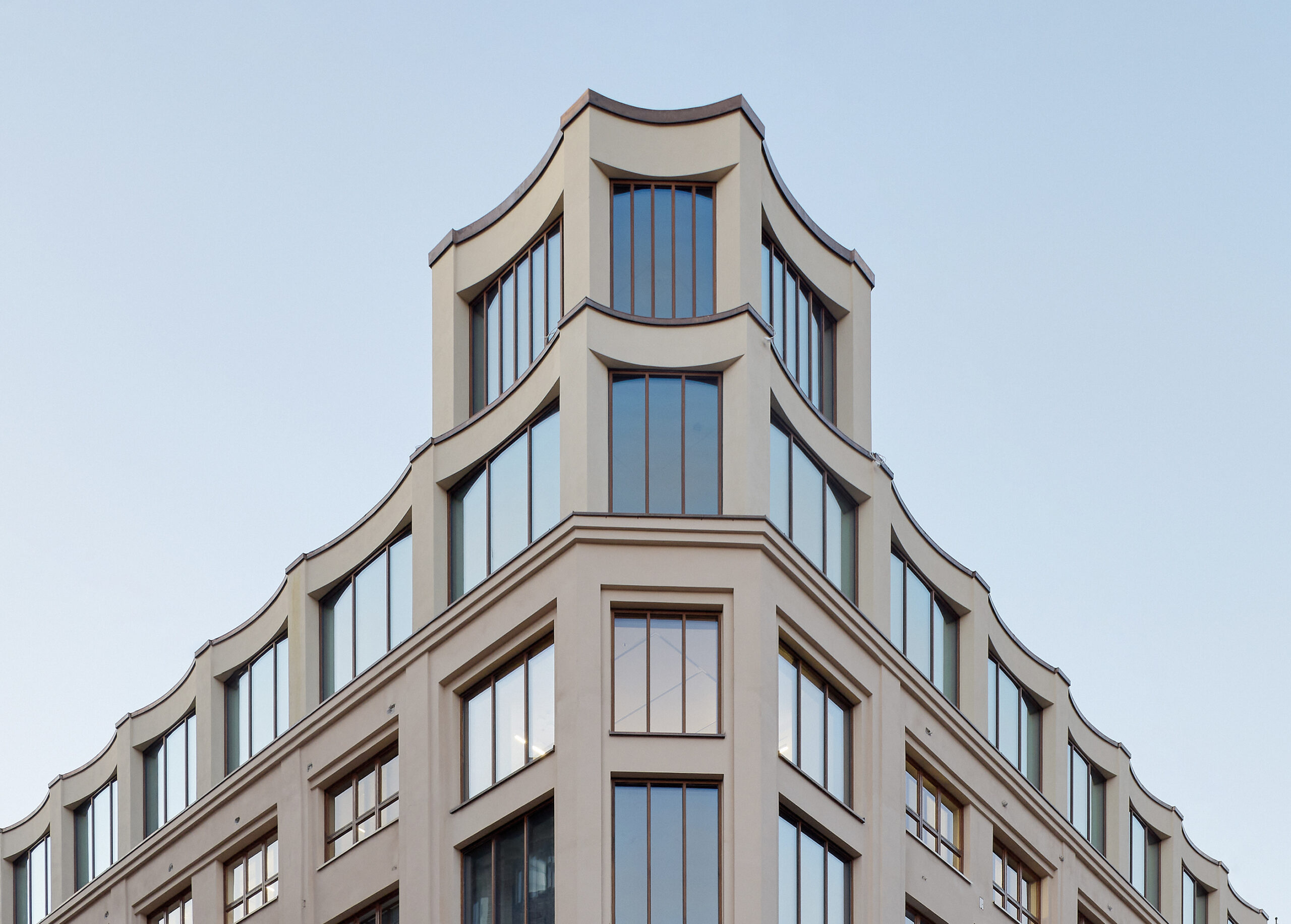
Mikonkatu 7 office building renovation and extension
Helsinki
2022
Kuva: Tuomas Uusheimo
THE 2023 APARTMENT BUILDING designed by Inaro on Kaarlenkatu in Helsinki is almost indistinguishable from the surrounding early 20th century urban fabric. The evenly spaced grid of windows is paced out by tall arched windows on the ground floor and borrows its proportions from the neighbouring buildings. The new top floor at Mikonkatu 7 by Futudesign extends a historical building from 1911 with a crown-like tower that looks like it has always been there, while the refurbished interior draws influences from mid-20th century office buildings. Sammontalo, a new comprehensive school and multipurpose building by Nervin Architecture in Lappeenranta, then, introduces a substantial roof structure that seeks to bring a sheltered atmosphere reminiscent of vernacular architecture into the everyday environment of schoolchildren. The school building is new but does not advertise its newness in relation to its surroundings. These are among the many examples of a New Historicist trend that is spreading through Finnish architecture.
New Historicism refers to architectural trends that not only pick up design references from history but, in doing so, also recontextualise the power and self-image of architects. The term was coined in a 2016 article by Alejandro Zaera-Polo in El Croquis, “Well Into the 21st Century: The Architectures of Post-Capitalism?”, in which he categorised rising architecture firms based on their projects and published writings.1
In Zaera-Polo’s view, the firms that he classified as New Historicists were applying historical references in their designs in an attempt to connect their work as part of a historical continuum and to create architecture for the sake of architecture, detached from the political and economic environment. In his article, he referenced the desire of this category of architects to reject the aesthetics of newness, including the influences of parametric design, and thereby the “superficiality” of the field. The objective of architectural aspirations that were removed from new trends and the political climate was, according to Zaera-Polo, to underscore the independence of the field.
New Historicism, then, is not a reductive term for an architectural style, as the project-based nature of modern architecture and, for example, the emphasis on the functionality of plans and designs has meant that the current conceptualisations of architecture are more detailed than simple representations of a specific style. Still, when it comes to aesthetics and the underlying design methodology, certain parallels can typically be drawn between projects interpreted as representing New Historicism. This is particularly evident in Finland, where the construction industry is small and a limited academic discourse has led to a condition in which mainstream architectural aesthetics can only accommodate one trend at a time.
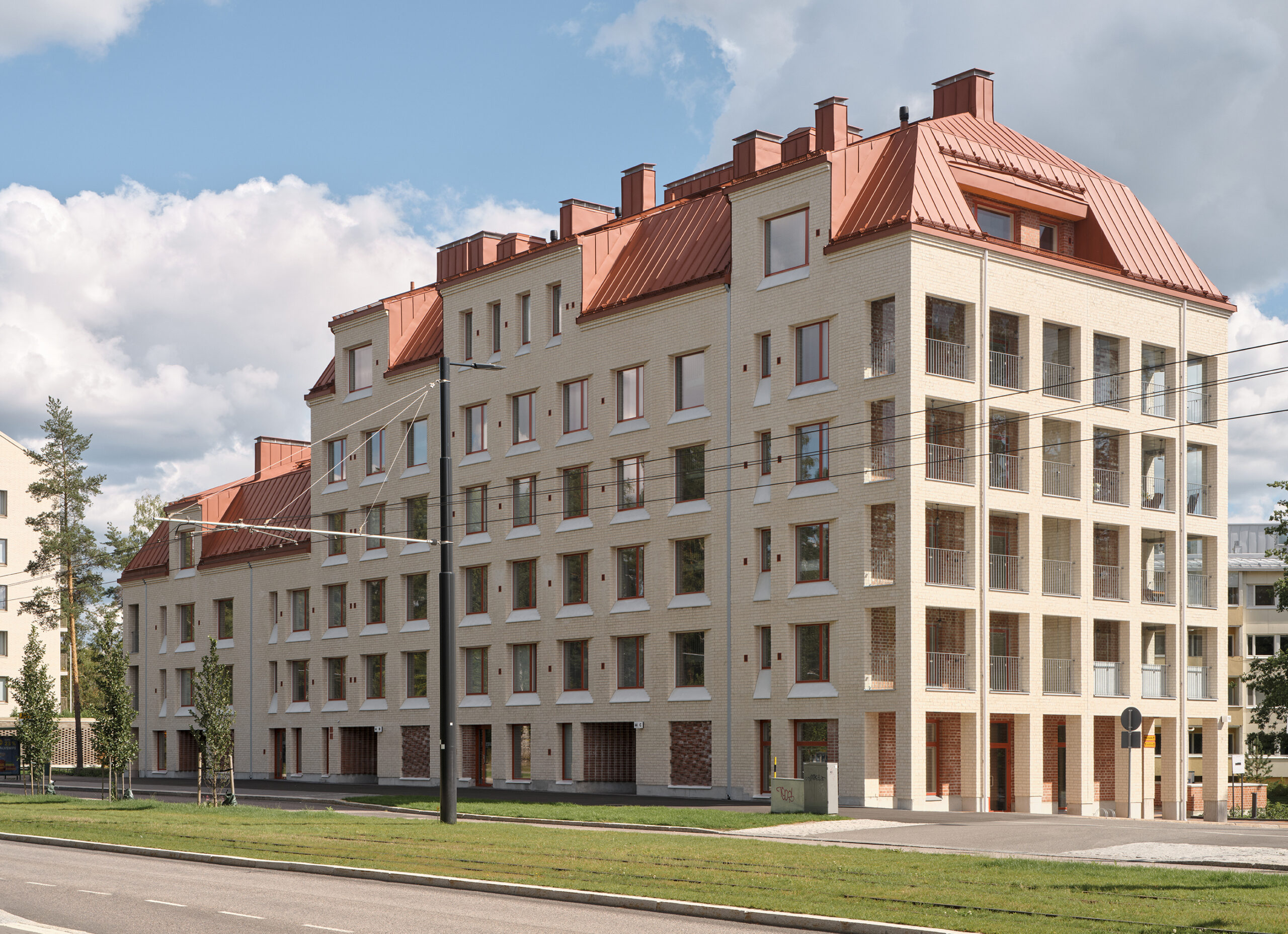
Helsingin Muurarimestari Housing
Helsinki
2024
Photo: Tuomas Uusheimo
Uushistorisismi ei tarkoita reduktiivisesti arkkitehtonista tyyliä, sillä modernin arkkitehtuurin kohdekeskeisyys ja suunnitelmien toiminnallisuuden painottaminen on johtanut siihen, että arkkitehtuuria käsitteellistetään nykyään yksityiskohtaisemmin kuin tietyn tyylin edustajina. Tästä huolimatta uushistorisistisiksi tulkittavissa projekteissa on yhtäläisyyksiä estetiikassa ja taustalla vaikuttavissa suunnittelumetodologioissa. Tämä on havaittavissa erityisesti Suomessa, jossa pieni rakennusala ja rajoittunut akateeminen diskurssi ovat johtaneet siihen, että arkkitehtonisen estetiikan valtavirtaan mahtuu yksi trendi kerrallaan.
When discussing New Historicist aesthetics, one must consider the fact that, in contrast to buildings that can be described as neo-traditional, the features of a New Historicist building can also be borrowed from 20th century modernism. This means that the buildings that are produced as a result of this trend can be quite varied in “style”. If a common aesthetic factor needs to be defined, one could say that a blurring of the line between old and new architecture is typical of New Historicist buildings.
Background in Switzerland
Zaera-Polo’s article examines the architectural field as a post-2008 reaction to the financial crisis without delving too deep into the historical origin of its taxonomic divisions. However, in terms of the arrival of New Historicism in Finland, the origin is a significant factor due to the strong influence of the Swiss architectural sphere that can be seen in the background. Many young architecture practices that are now establishing themselves in the field have gleaned notable influences or learning from Swiss architects, and the same can also be said of our already established firms.
The very identity of the ETH Zürich Department of Architecture is rooted in the strong influence of Aldo Rossi, who taught at the university in the 1970s. One could even claim that modernism never created the same kind of rift between the present and the past at ETH Zürich as it did in many other schools of architecture because the emphasis on the French Beaux-Arts tradition of classical drawing, painting and model building, combined with the design of new buildings, had remained a staple of the school’s pedagogic practices up until the 1970s. The arrival of Rossi and the rise of postmodernism led to the pre-existing status of historicism to become even stronger and instilled in the school’s identity. This also left a profound impact on the Swiss architectural field, when Rossi’s students established themselves in both the practice of design and academia.2
Miroslav Šik, a student of Rossi’s and a significant figure in his own right in the academic circles of Switzerland, albeit not well-known outside the country, went on to teach numerous Swiss architects who have made a name for themselves, such as Christian Kerez, Paola Maranta, Andrea Deplatzes, and Valerio Olgiati. Šik’s methodology, which he presented in Analoge Architektur in 1987, emphasised the application of historical references in the design of new buildings and imprinted Swiss architects with a perspective that questions “newness” when analysing their work. There have, of course, been several other teachers at ETH Zürich who have been significant in the context of New Historicism over the decades, such as Hans Kollhoff and Adam Caruso, but Šik’s influence is distinguished in its duration and academic formalisation. He retired from his tenure as Professor in 2018.
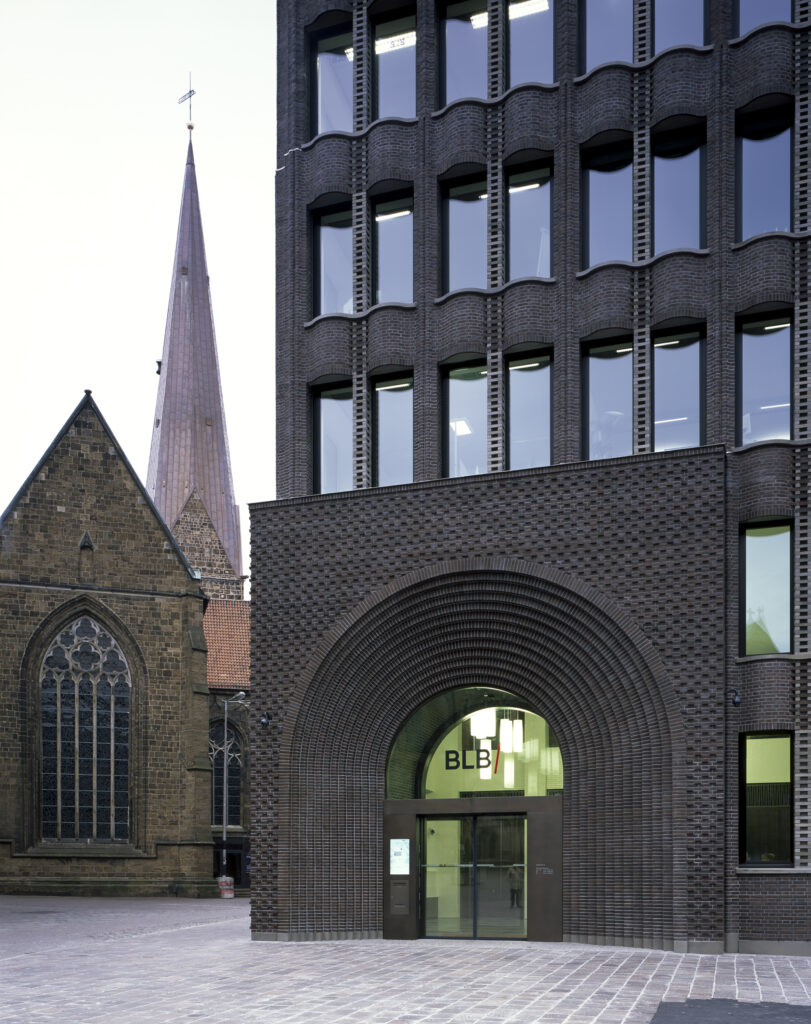
Bremer Landesbankin pääkonttori
Bremen
2016
Photo: Hélène Binet
Influence in Finland
Among the trends that influenced Finnish architectural aesthetics coming into the 2010s were the populism disseminated by Bjarke Ingels Group and the material fundamentalism hailing from Central Europe that fetishised the presentation of “pure” materials and structural cause-and-effect relationships in architecture. These were quick to weave themselves into the Finnish arena of architectural competitions that focuses on programmatic efficiency: populism enabled the veiling of designs in linear simplicity, while material fundamentalism offered a means to arrange architectural elements without relying on systems of proportion, let alone ornamentation. These new currents were born as a result of, or as counter-reactions to, more complex design trends that were at play in the 1990s and 2000s.
For Finnish students of architecture who started their studies in the 2010s, material fundamentalism and populism became the established framework of architecture. This design ethos, which was quite superficial to a certain extent, was perhaps one of the reasons why the objective of New Historicism to connect contemporary architecture as part of a historical continuum was so impactful with new graduates. At the same time, Mikko Heikkinen, who was a professor at Aalto University in 2010–2015, and his colleagues were introducing their students to renowned Swiss architects, which created interest in the practice of architecture in Switzerland.
Aalto-yliopistossa professorina toiminut Mikko Heikkinen kollegoineen teki sveitsiläiset merkkiarkkitehdit opiskelijoille tutuksi.
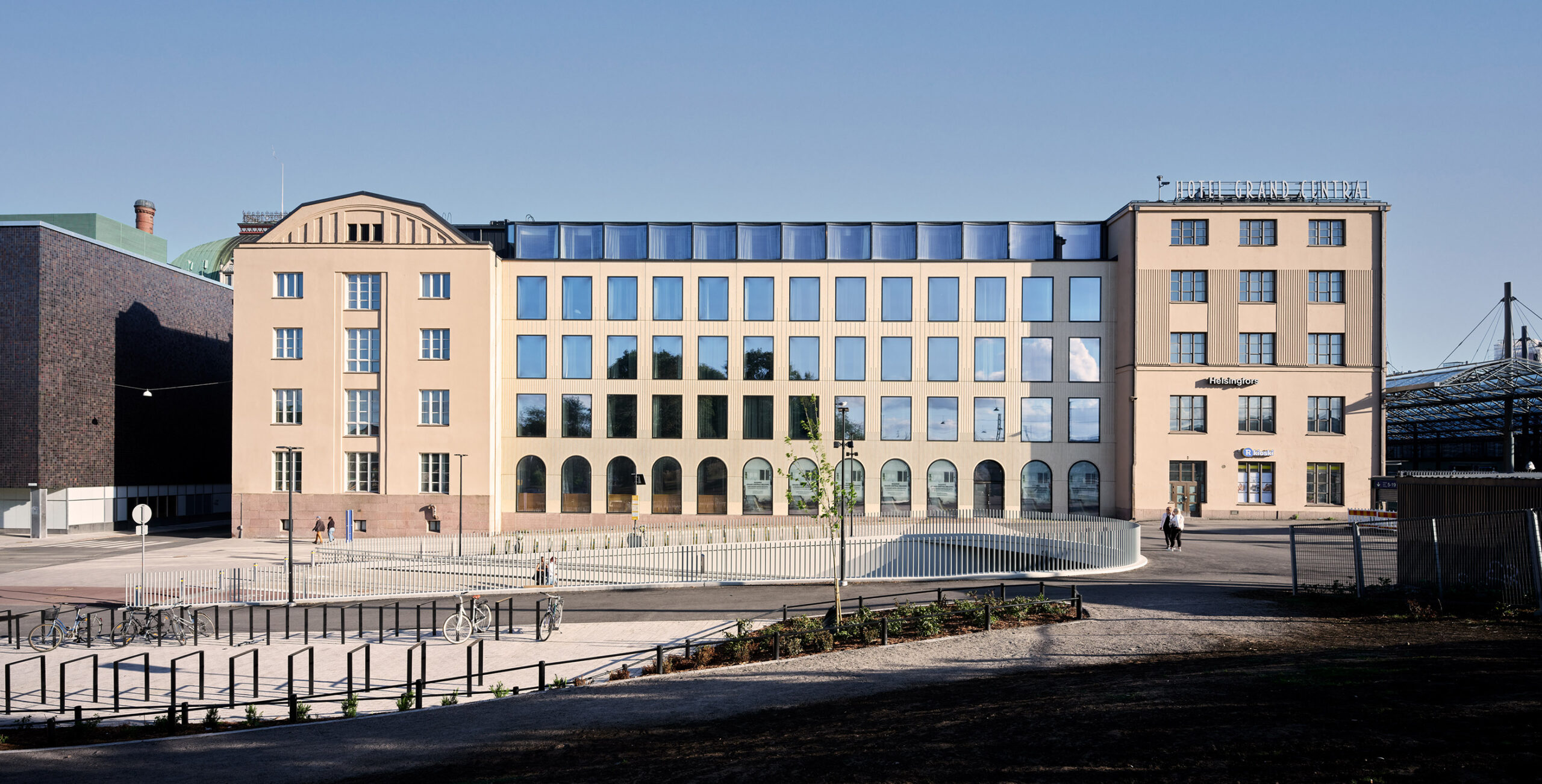
Scandic Grand Central Hotel
Helsinki
2021
Photo: Marc Goodwin
It is always difficult to determine the exact moment when a new trend is conceived. With the limited architectural discourse in Finland, however, competition wins emerge as significant milestones in the development of architectural trends. Viewed through this lens, the New Historicist perspectives inspired by the Swiss architectural tradition were highly influential in Finland throughout the early 2000s.
A good example of such an influence is Esa Ruskeepää’s win in the design competition for the Opinmäki School in 2011. The resulting building represents material fundamentalism, but its evenly spaced, uncompromising exterior and the monumental, cast-in-situ concrete of the interior speak of Swiss references as an underlying influence. Also, Ruskeepää worked in Switzerland before designing the school.
The first clear example of a New Historicist competition win in my view, however, is Futudesign’s proposal for the new hotel at Helsinki Central Station from 2017, which entailed distinct references to the station building’s early-20th-century architecture and developed the style further. The new extension was not marked off with a clear contrast from the adjoining old buildings, which went against the Venice Charter that remains influential in Finland to this day. It is also of note that one of the competition team members and partners in the competing firm, Teemu Seppänen, had studied at ETH Zürich.3
Another tick in the column of the rise of New Historicism is seen in the numerous competition wins scored by Opus Architecture since 2016, which have most definitely made the trend more popular among Finnish architects.
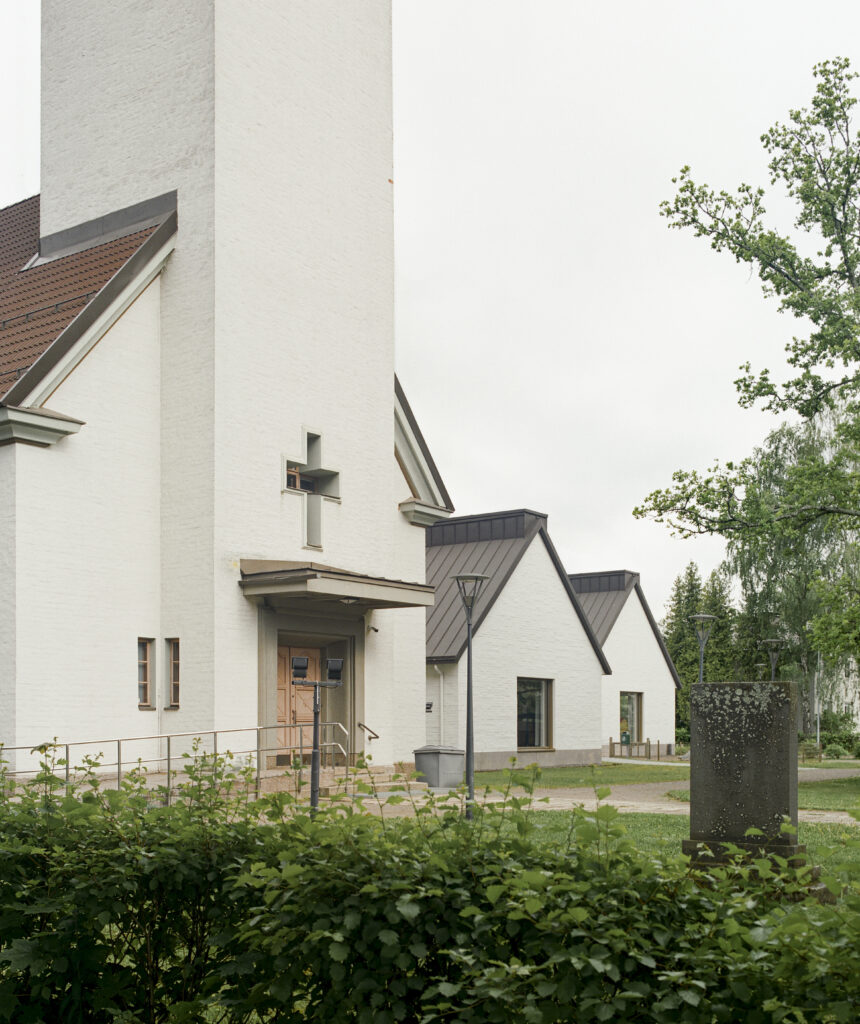
Zealand Design
Myllykoski Church Extension
Kouvola
2020
Photo: Kalle Kouhia
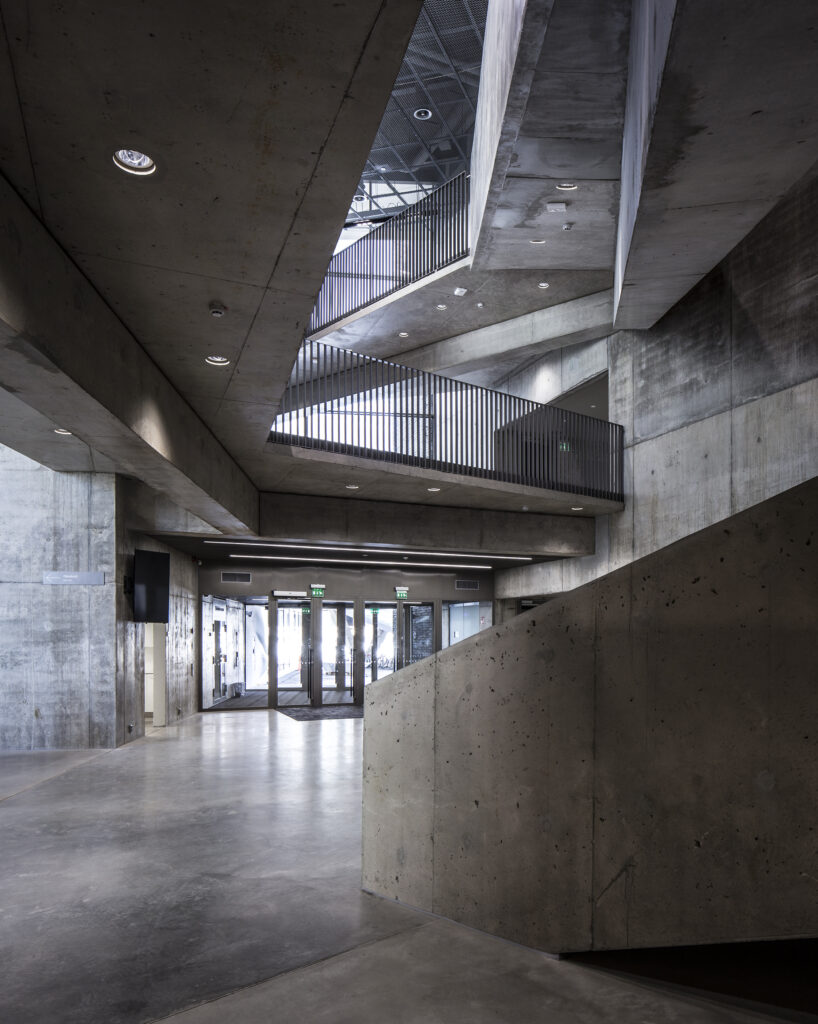
Opinmäki School
Espoo
2015
Photo: Antti Canth
When it comes to the generation of architects that is currently establishing itself in the field, the Sammontalo competition win by Nervi Architecture in 2019 is also noteworthy from the perspective of New Historicism in that two of the three partners in the firm studied architecture in Switzerland. The designers wished to tie in the school building as part of the surrounding urban fabric by reiterating the brick facades of the public buildings in the area designed by Sulo Savolainen in the 1980s and 1990s. In contrast to what is often the case in modern Finnish architecture, the interior spaces of Sammontalo are not clad in pale-coloured wood; instead, the material world reflects the dark tones of the exterior. The most significant aesthetic factor, however, is the architects’ decision to emphasise the small details, lines and boundaries within the building with changes in colour and material. This sets Sammontalo apart from many other modern Finnish buildings, in which the choice is usually to diminish such small-scale structural elements.4
The architects who went to university in the 2010s – and, on a broader note, the entire profession in Finland – are divided in their approach to New Historicism and their application of this trend in their own design work. Some of the 2010s students went to study in Switzerland or otherwise received learning and influences from architects who positioned themselves within the framework of New Historicism, which inevitably shaped their methods through the knowledge and information received directly from the source. For others, the interest in New Historicist or Swiss architecture developed from within Finland, and their design work was shaped through an imitation of the Swiss traditions as well as observations and perceptions thereof. For the majority of Finnish architects, however, shifts in trends enter their own work through the results of Finnish architecture competitions and other publications.
The distance from the original source presumably yields differences in design methods and objectives, which can be seen in, for example, the application of design references. In Switzerland, whenever references are applied, the typical process includes a careful examination of the background of the building from which the designer borrows, which allows the further development of the referenced elements through their original context. The art of reference, then, is not reduced to a mere collage but establishes a dialogue with the building that serves as the source of the borrowed elements. The aspect of how far removed the architects are from the source material offers an interesting perspective for the current and future study of Finnish New Historicist architecture.
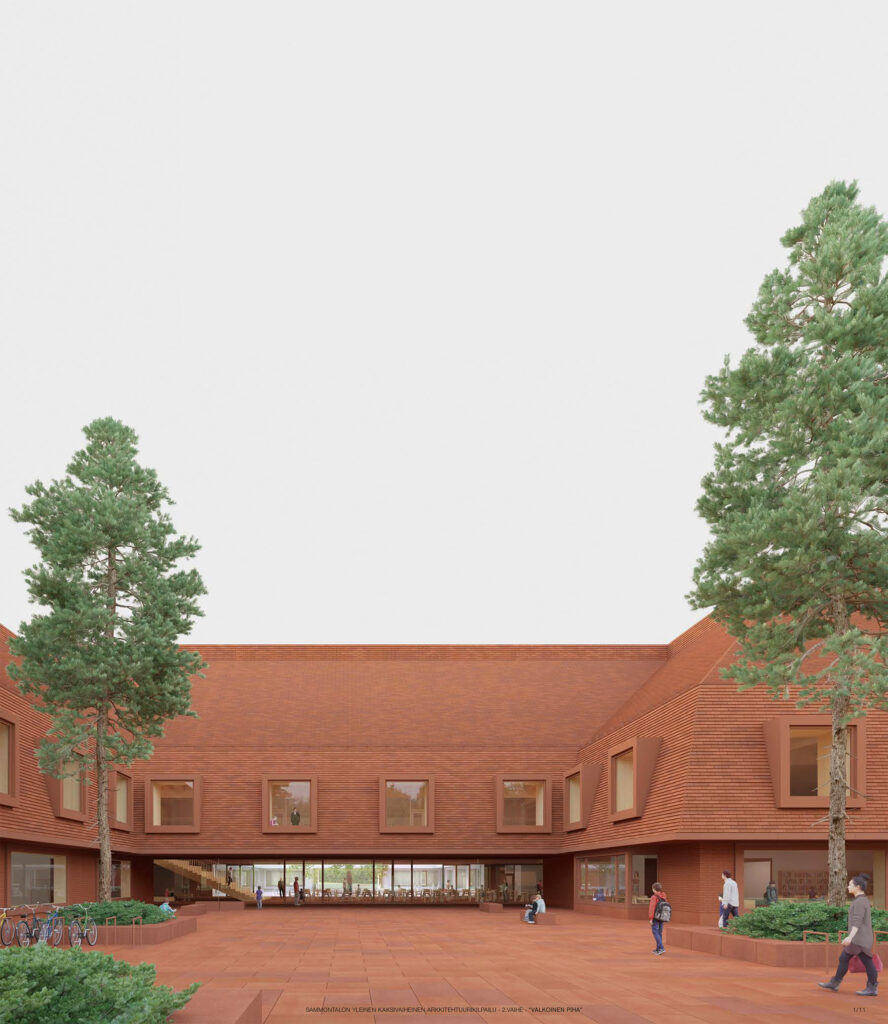
Sammontalo
competition proposal (1st prize)
Lappeenranta
2019
Visualisation: AS LL TK
Finnish Counterforces
The rise of New Historicism cannot be discussed without mentioning its Finnish counterforces that arise from the past and future alike. The earlier-mentioned programmatic efficiency is still steering design and limiting the diversity of Finnish architecture regardless of the changing currents of architectural trends. New Historicist design could denote the application of references in, for instance, the drawing-up of floor plans, all the way to a partial copying thereof. This, however, is something that architects are often not free to do due to the constraints of the programmatic design paradigm.
On the other hand, the limited selection of building products tends to translate as rather uniform facade architecture, which could even facilitate the spreading of the New Historicist trend. The ability of the product range to respond to changing design objectives is typically best seen in the facades of buildings. The widening application of specific products establishes specific trends as a visible part of the Finnish history of building. Here, one might ask whether Finnish New Historicism is in danger of being reduced to a facade style; if a trend fails to lead to anything beyond even grids of fenestration, a whole world of its potential remains untapped.
At its best, New Historicism gives designers the opportunity to dive into historical design traditions, lift some of last century’s unwritten rules of architectural design, and open up new, less-studied avenues of design work. Such an end result will surely not be achieved without some stumbling blocks; for instance, the learning of classical facade composition and decoration has been sorely overlooked by architects trained during the era of modernism, which means that gaining an in-depth understanding of the opportunities yielded by these aspects of design will inevitably take time.
New Historicism gives designers the opportunity to lift some of last century’s unwritten rules of architectural design.
Regarding future counterforces to New Historicism, one could mention the impacts of sustainability thinking on architectural expression and the political baggage of classicism. The concern over climate change, which has intensified since the 2010s, has again brought politics into the Finnish architectural discussion, and, as a result, renovation and restoration, for example, have emerged as an architectural virtue. The sustainability mindset can very well become a factor that promotes the aesthetic development entailed in New Historicism, as renovation inevitably forces the designer to reflect on the relationship of new building components to the old ones, but it can also lead to architecture being valued solely through its political confluences. For instance, if life-cycle considerations cause technical sustainability to be viewed as a virtue that trumps all other aspects of design, aesthetics as an element of cultural sustainability will be pushed to the side, which would mean that the development of New Historicism would be cut short.
Politics also come into play in comments made by Western far-right and conservative circles, idealising new buildings with a traditional design. For example, President Donald Trump gave an administrative order in January 2025 to promote the designing of US federal buildings in accordance with classical design principles.5 In Finland, the Arkkitehtuurikapina (“Architecture Uprising”) community that is active on social media seeks to increase the popularity of classical and neo-traditional-style buildings. The community draws from the Intbau organisation founded by King Charles III, which is attempting to bring back historical architectural styles into contemporary design practices.
However, in the minds of most modern people, the connection of classical architecture to power, and to those in power, has been severed by now, which means that neo-traditional architecture is also reduced to its aesthetic qualities alone. Due to the current development in political conservatism, New Historicism is in danger of being labelled in a similar way. If the design trend is to be viewed solely through the narrow lens of neo-traditional design, it will lose a significant part of its substance and be reduced to superficial conservatism.
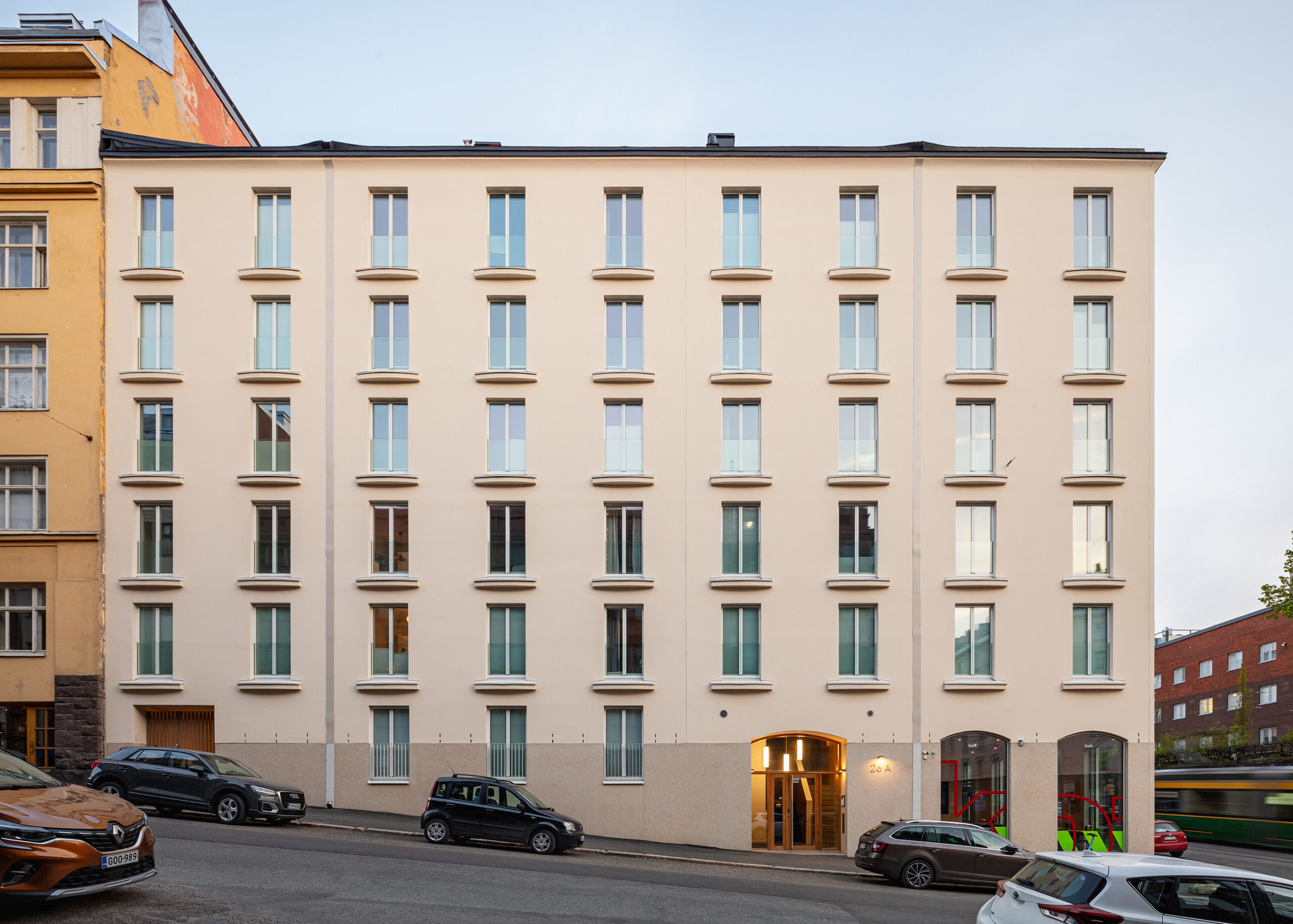
Kaarlenkatu Housing
Helsinki
2022
Photo: Sami Saastamoinen
Trend Setters or Followers?
The fate of New Historicism in Finland remains to be seen, but its dominion at ETH Zürich in Switzerland already seems to have been breached. The trend moved from Switzerland to the US in the early 2000s, where it was met by a more playful take than in Europe. American architects began to develop New Historicist aesthetics with the tools of the formalist tradition, for example, introducing features that nod towards a new type of postmodernism. The firms Johnston Marklee and MOS are examples of this type of adaptation. However, the trend is primarily visible within American architectural academia when it comes to design aesthetics. This development, then, is now exerting an influence on the architectural education, professor selections and course themes at ETH Zürich as part of a political awakening of the academic circles in Switzerland and will undoubtedly have a wider impact on Swiss architecture once the new mindset is transferred from academia to practice. It is interesting to see Swiss architects seemingly reinventing themselves as the appreciation for Swiss design methodology grows outside the country.
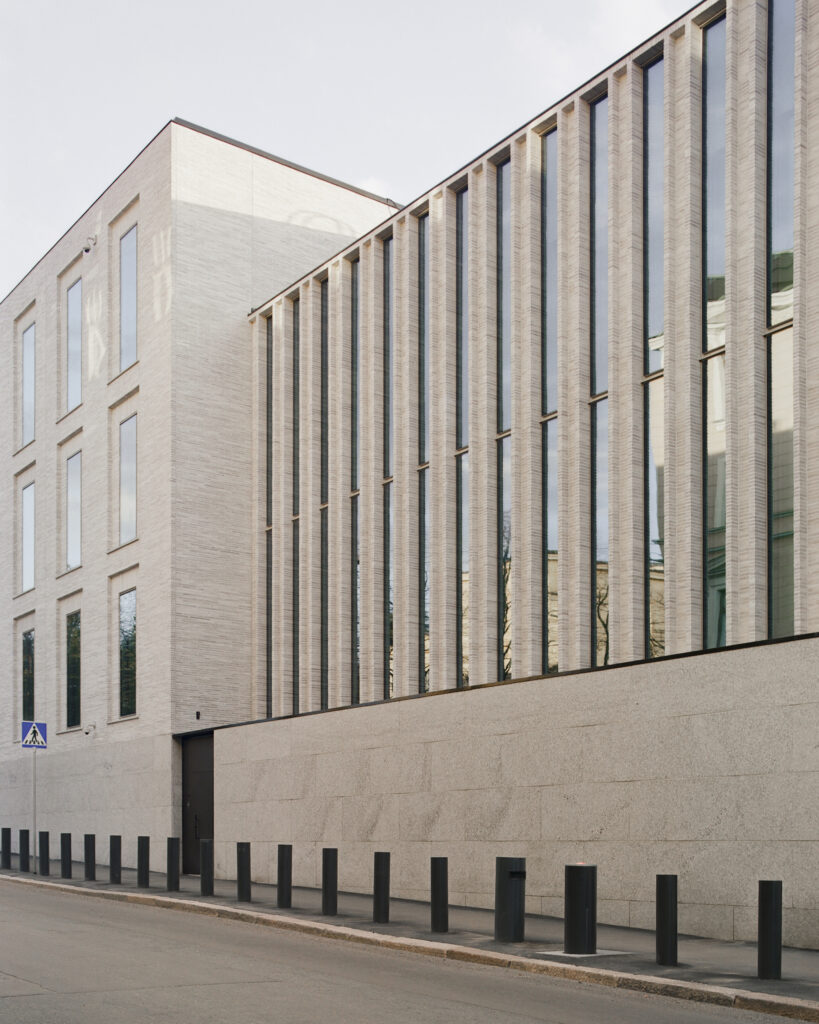
Kaarti Block Infill
Helsinki
2025
Photo: Kalle Kouhia
The attempt of New Historicist architects to disconnect their work from the cycle of novelty enforced by the financial system will appear in an ironic light, if the trend remains detached and fails to establish itself as part of the architectural tradition, as it has done in Switzerland. Miroslav Šik’s analogue architecture was based on a perspective on new architecture as part of a historical continuum. This view contributed to a consistent and timeless cityscape in its own context. What was essential was that this mindset was instilled through architectural education in generation after generation of Swiss architects, which allowed it to become a permanent undercurrent within Swiss architecture.
Indeed, one might ask whether a key element of this trend has been lost with the very act of its spreading beyond the Swiss context.
Elements of the type of new postmodernism mentioned earlier in this article can already be seen in Finnish architectural aesthetics – for instance, in the wavy roof forms presented in the entry entitled “Tyrsky” that was one of the finalists in the newly settled design competition for the new Museum of Architecture and Design. Will new postmodernism live on in parallel with Finnish New Historicism, and will Finnish architects learn to combine classical and modern design into an idiosyncratic whole – or will the New Historicist trend be sidelined by the economic slump and get replaced with a different trend before it has even had time to take hold properly?
Trend cycles come and go, but what is key here is how the architectural profession recognises, examines and develops the trends. This will determine whether new architectural trends from Finland will flow out into the world, or whether we will continue to remain on the receiving end of new currents. ↙