The beauty of the new Nokia Campus in Oulu lies in precision
The architecture of Nokia’s new campus is as refined as the design work and manufacturing carried out there, writes Lauri Louekari.
Nokia Campus
ALA Architects / Juho Grönholm, Antti Nousjoki, Samuli Woolston
Typology offices and industrial production
Location Ritaharjuntie 3, Oulu
Gross area 56 900 m2
Completion 2025
More photos and drawings of the project →
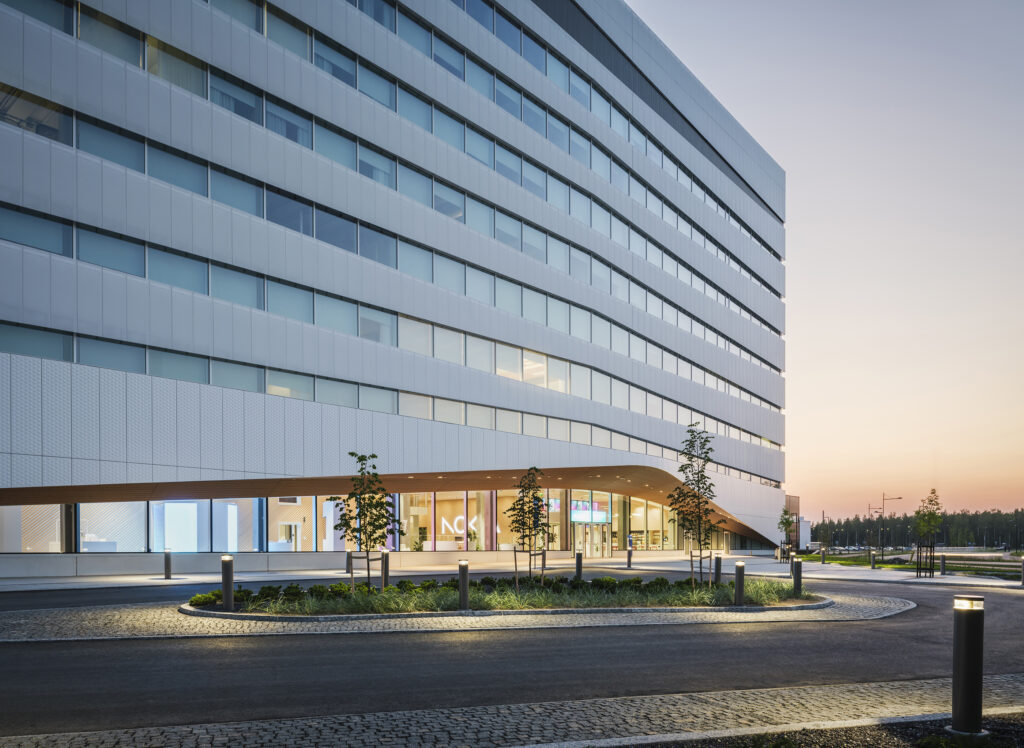
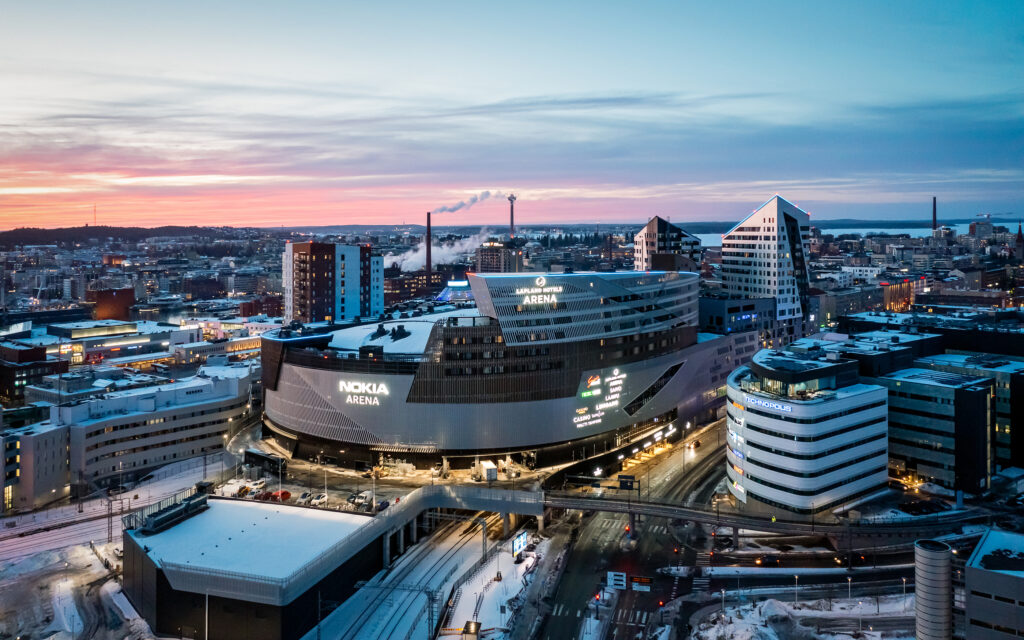
ANYONE DRIVING along Finnish National Road 4 to Lapland will be struck by Nokia’s new campus north of Oulu city centre. The premises have a neutral appearance and seem to consist of white and black metal-coated boxes. As one approaches the main entrance, one notices that extensive production facilities spread out behind the tall office section and there are separate technical units along the edges of the area. The impression is nevertheless still ordinary. However, a familiar Nokia mathematician told me that in order to get a seat in the building for the day, you have to make a reservation a couple of weeks in advance. There must, in other words, be something special about the place.
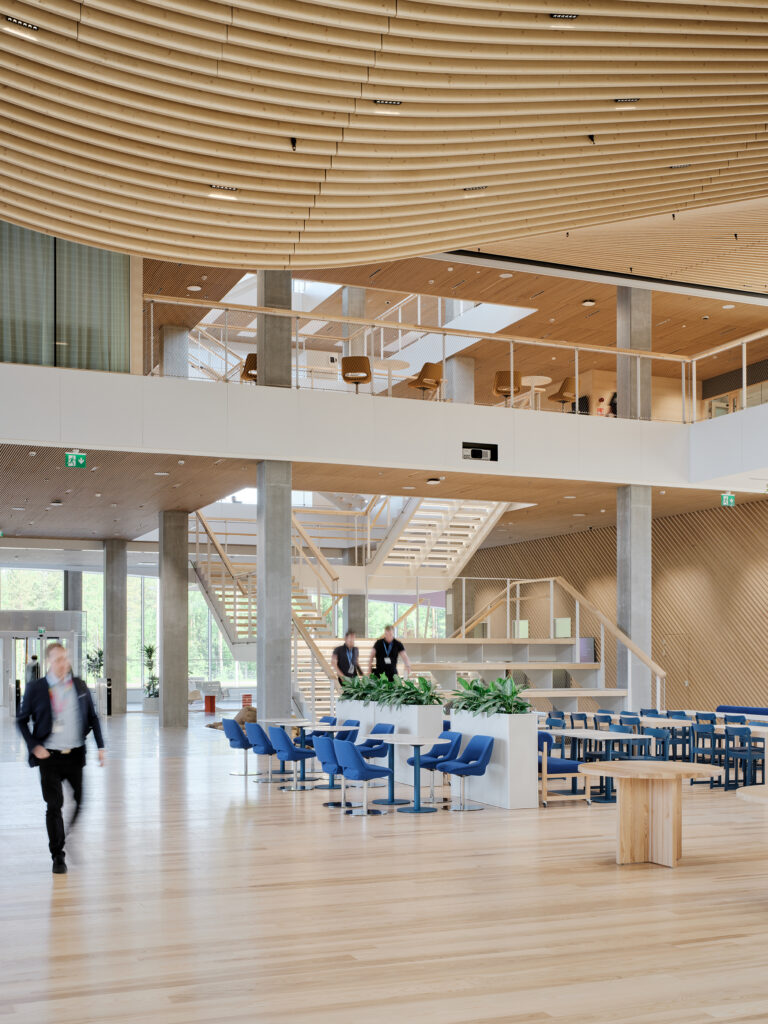
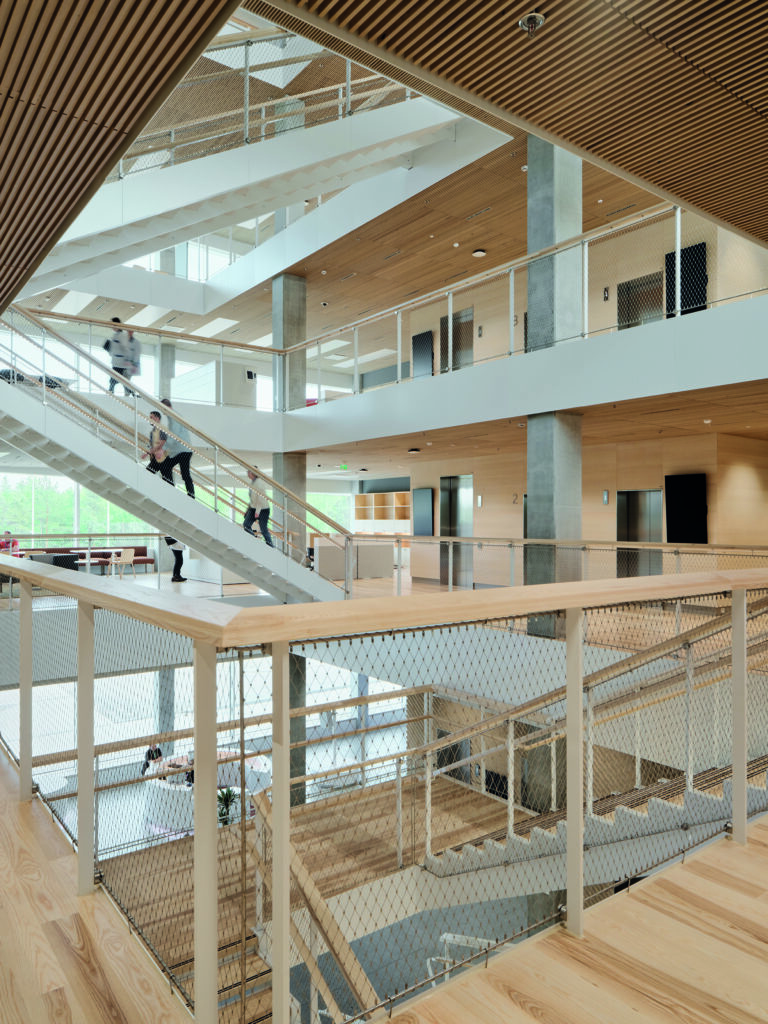
The reason for the new enthusiasm to return to on-site work is already revealed when entering the main lobby. The space is exceptional. The lobby is T-shaped in layout and spans several storeys. The space opening towards the front and upwards, is varied and bright. Everywhere the eye encounters impeccable, precise finishing, including the wooden surfaces; they are found on the ceiling in the form of narrow battens and on the walls in the form of solid wooden diagonal panelling, the strong relief of which brings to mind the spruce forest that opens up from the lobby.
The integration of technology into the structures and surface textures is also flawless in its precision, and the artificial light complements the natural light with an effortlessness that is rarely seen. One gets the feeling that the architect has mastered the process with a certainty that is comparable to the design of a technical product. Form, space and function are incorporated into a whole, in which the user’s role is only to take possession of a functional product.
The precise finishing of the architecture seems to refer to the quality of the design and manufacturing carried out in the building. The building becomes a symbol of the work being carried out there. The elegant, rational offices designed by Eero Saarinen for the General Motors Technical Center in Michigan in the 1950s come to mind, the symbolic meaning of which seems to deliberately reflect the product-s precision and reliability.
The building has other features too of a modern machine. I visited the site on a day in February, when the temperature outside was around twenty degrees Celsius below zero. Just like Marjatta and Martti Jaatinen’s Oulu Central Library (1982), a large, uniform air space is created, with a steady, draft-free temperature of twenty degrees. The illusion of an artificial summery world is impressive: in the lobby café an Indian information worker works intently, and large groups of people move around on the different levels amidst an acoustically pleasant artificial nature. There is no doubt, people come to work here because of the building’s well-functioning architecture. For a moment, faith is restored in the potential of modern architecture and its principles proclaimed by Le Corbusier a hundred years ago. It is difficult to create such an entity other than by relying on reinforced concrete pillars. Flat roofs and strip windows, also familiar from the architecture of the Oulu Central Library, are also reminiscent of the old Le Corbusier manifesto.
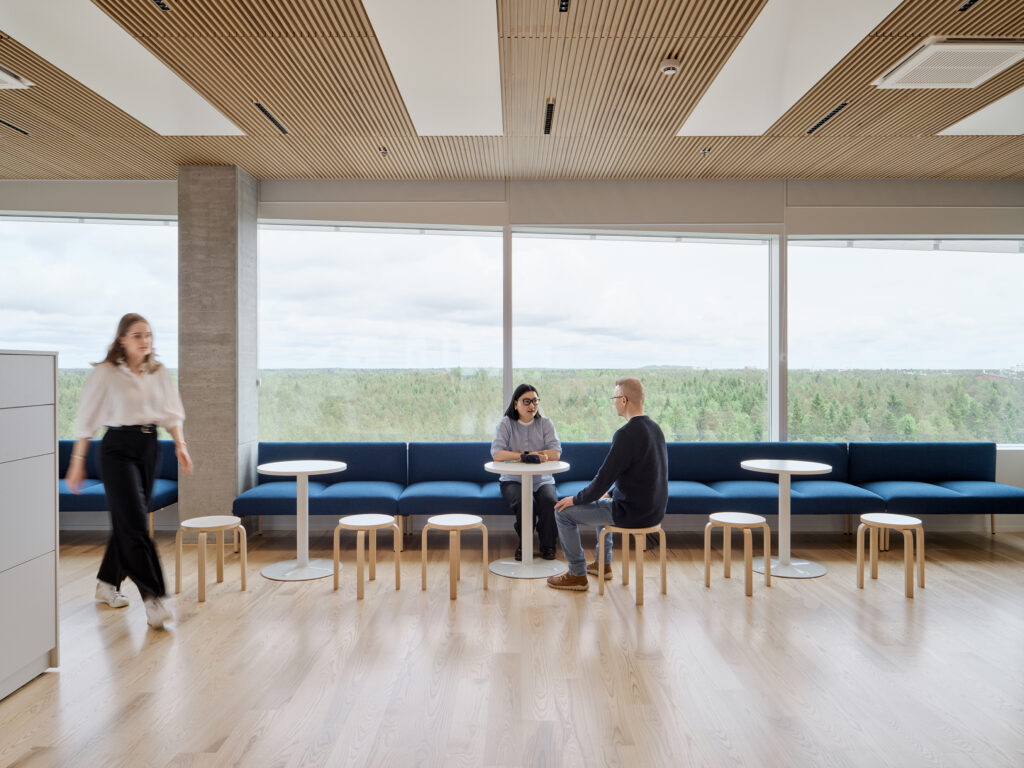
The library and the new Nokia campus also have similarities that touch on the ethics of architecture. In both, under the shelter of a restrained, even austere, outer shell, there is a festive and at the same time sympathetic interior. But unlike the library, in whose mathematical perfection each pillar stands in its own sacred place, the Nokia lobby has a relaxed atmosphere, anticipated by the soft-shaped cantilever, a characteristic feature of ALA Architects, that shelters the main entrance. Both buildings have a high, central space, the size of which is such that it is difficult to convey in photographs. The space has to be experienced physically by moving about in it, allowing views to open up in many directions, forwards, to the sides and upwards.
At the same time, the building is modern machine also technically: flashy and well-functioning when new. On the other side of Oulu, the University Hospital (Reino Koivula 1976), which was built when I was a student in the 1970s, is currently being demolished. Its eavesless flat roofs covering an area of several hectares have been leaking for decades, and the wards on the top floors smelled of mold. The same seems to be true of the old part of the University of Oulu’s Linnanmaa campus (Kari Virta 1980), which features the same solutions typical of that era and which the university has decided to replace with a new one. One reason for replacing the building has been its high repair costs.
We are tied to this type of production, and there seems to be no easy way out. Our beautiful machines are designed to become obsolete within half a century, while our log churches have been standing for four hundred years.
Also these might interest you
Advert